ℹ️ Before you start
The CaVeSal® Calculator has 7 tabs in the header — 📋 Ficha prenatal (Prenatal record), 📊 Resultado (Result), 🗓️ Gestograma·Parto (Gestogram·Delivery), 🔊 Ecografía (Ultrasound), 👤 Pacientes (Patients), 🎓 Simulador (Simulator) and ℹ️ Acerca (About) — and this manual is organized in that same order: each part below corresponds to a real tab in the app, and each subsection to a card (or sub-tab) inside it. The app interface is in Spanish; button and field names are shown as they appear, with their translation. In the demo, Patients and Simulator appear with a lock 🔒.
Within each tab, cards work as collapsible sections: tap the header of each one to open it, enter the available data, and the result updates automatically as you type — no "Calculate" button is needed for individual calculations. The "⚡ Calcular" (Calculate) button in the header (visible on every tab) builds the consolidated comprehensive prenatal risk report (📊 Result tab), gathering all findings from every tab.
All calculations are done on your own device, without an internet connection or sending data to external servers.


📋 Prenatal record
What you enter when opening a patient: general data, history, habits, current pregnancy, prophylaxis, laboratory and metabolism. It is the foundation that feeds the rest of the calculator.
📋 General data
Enter maternal age, LMP, height, pre-pregnancy and current weight. The LMP syncs automatically with the 🗓️ Gestogram·Delivery tab, the vaccine traffic light and the mode of delivery — no need to repeat it elsewhere.
If you enter an early ultrasound in Gestogram·Delivery, this card receives the correction automatically. Correction criteria: 1T (<14 wk) ≥5 days' difference · 2T (14–28 wk) ≥7 days · 3T (>28 wk) the LMP is not corrected.
Enter systolic and diastolic BP. If you enter any value, the app automatically shows the extended hypertension fields: proteinuria (negative / trace / ≥1+ dipstick / PCR >0.3 / ≥300 mg/24h / ≥2 g/24h nephrotic range) and vasospasm symptoms (severe/frontal headache, tinnitus, photopsia/scotomas, epigastric/RUQ pain, dyspnea/pulmonary edema).
🍼 Obstetric and personal history
Obstetric history
Enter pregnancies, births, cesareans, miscarriages and the interpregnancy interval (months) — with this the app automatically builds the obstetric formula (G/P/C/A) that you will later see repeated in the "Mis pacientes" (My patients) record.
Tick the obstetric risk history: previous preeclampsia, previous gestational diabetes, previous preterm birth, previous FGR, previous macrosomia (>4000 g), previous fetal death, previous fetal malformation, previous PPH, previous isoimmunization, previous cervical insufficiency, previous postpartum depression, previous uterine surgery.
Personal history
Cardiovascular/metabolic: chronic hypertension, pregestational diabetes, chronic kidney disease, pre-pregnancy obesity (BMI≥30), moderate/severe asthma. If you tick Heart disease, a sub-block opens to specify the type (congenital ASD/VSD/Fallot/other, valvular, cardiomyopathy, arrhythmia) and the modified WHO classification of cardiovascular risk in pregnancy (I to IV, with IV = pregnancy contraindicated).
Thyroid: treated hypothyroidism, untreated hypothyroidism/Anti-TPO+, hyperthyroidism/Graves (Anti-TRAb+).
Coagulopathies and thrombosis: inherited thrombophilia, APS (Sydney 2006 / ACR-EULAR 2023 criteria), previous DVT, previous PE, thrombocytopenia/purpura, Von Willebrand/hemophilia carrier.
Neurological/immunological: epilepsy, documented MTHFR polymorphism, autoimmune disease (SLE, RA, Sjögren, scleroderma), mental health (depression/anxiety/bipolar disorder).
Oncological: previous cancer in remission (with type: breast, cervix, thyroid, hematological, melanoma, other) and, separately, active cancer during pregnancy (with type and ongoing treatment).
Infectious (history): HIV on ART, chronic hepatitis B (HBsAg+), hepatitis C (Anti-HCV+), syphilis (history/on treatment).
🧠 Habits and psychosocial environment
Tick whatever applies: active smoking, alcohol use, drug use, domestic violence, socioeconomic vulnerability, vegetarian/vegan diet. Each one is integrated into the comprehensive risk report with its own suggested management (e.g. a vegetarian/vegan diet adjusts the recommended supplementation).
🤰 Current pregnancy
Tick the findings of the ongoing pregnancy: multiple pregnancy, assisted reproduction (ART), vaginal bleeding, Rh negative, positive indirect Coombs/antibody screen, GBS positive (35–37 wk), placenta previa, polyhydramnios, oligohydramnios, threatened preterm labor, short cervix (<25 mm), reduced fetal movements, discordant fundal height, symptomatic UTI, vaginosis/vaginitis.
If you ticked assisted reproduction (ART), the app flags it as a risk finding (higher risk of placenta previa, preeclampsia and twins) — this is also repeated automatically in the "Mis pacientes" (My patients) record.
Active pregnancy disease (tick only if the patient already arrives with an established diagnosis in this pregnancy): ongoing preeclampsia, gestational hypertension, already diagnosed gestational diabetes, FGR confirmed by biometry, intrahepatic cholestasis (ICP), hyperemesis gravidarum/intractable vomiting, HELLP syndrome, placental abruption.
💉 Prophylaxis and vaccination
Ref: CDC · WHO · ACOG · FIGO 2024 · National Immunization Committee
Tick the vaccines already given (Tdap, influenza, RSV, COVID-19, Hepatitis B) with their date and gestational age and, if applicable, whether folic acid was started (the latter is grouped with the vaccines under the "Prophylaxis" domain of the report).
The app shows the status of the schedule and what is still pending according to the current GA, with the specific management for each one:
🔹 Influenza: inactivated vaccine, safe in any trimester. Priority in heart disease, diabetes, asthma, obesity, immunosuppression, HIV. Never use live attenuated influenza vaccine (LAIV) in pregnancy.
🔹 COVID-19: mRNA vaccines (Pfizer/Moderna) recommended by WHO, CDC, ACOG and FIGO. Safe in any trimester — pregnant women are at higher risk of severe COVID. Booster if >6 months have passed since the last dose.

🧪 Laboratory
Ref: WHO · ACOG · ISSHP · Endocrine Society 2024 · CDC · EMTCT Plus 2024/PAHO
An extensive module, organized into sub-areas. Enter only the values you have — each one is interpreted independently.
🩸 Blood count and coagulation
Hemoglobin: anemia if <11 g/dL in 1T or <10.5 g/dL in 2T-3T (WHO). Platelets: normal 150–400 (×10³/mL), <150 = thrombocytopenia. PT/INR (normal in pregnancy 0.8–1.2) and aPTT (normal 25–40 s). You can also tick positive proteinuria and positive urine culture as findings.
🫘 Renal profile
Creatinine (normal in pregnancy <0.8 mg/dL), uric acid (normal <5.5 mg/dL — early PE marker if elevated together with hypertension), urea (normal 10–40 mg/dL).
🫀 Liver profile
AST and ALT (normal <40 IU/L, suspicious if >70), LDH (>600 IU/L = HELLP criterion), total bilirubin (normal <1.2, suspect cholestasis), alkaline phosphatase (normal up to 3× ULN due to placental origin). The app combines automatically: elevated AST/LDH + thrombocytopenia = HELLP criterion, with management of immediate hospitalization, lung maturation if <34 wk, and individualized delivery.
🍔 Lipid profile
Total cholesterol (rises physiologically in pregnancy), triglycerides (>400 mg/dL = risk of pancreatitis), HDL, LDL.
🔬 TORCH serology
Toxoplasmosis (IgG/IgM/IgG avidity — key: IgG+ in 1T = immune, do not repeat; IgG− = susceptible, repeat every trimester; IgM+ = request avidity test), Rubella (IgG/IgM), CMV (IgG/IgM/IgG avidity).
🧬 Vitamin D, Ferritin and Transferrin saturation
Serum vitamin D: request in obesity, dark skin, low sun exposure or vegetarians (deficiency <20, insufficiency 20–29, optimal ≥30 — Endocrine Society 2024). Ferritin: request if iron-deficiency anemia is suspected (deficiency <15, low 15–30, normal >30). Transferrin saturation: normal 16–45%, <16% = functional iron deficiency.
🦋 Thyroid
Enter TSH together with the trimester of the test — the app applies the corresponding reference value (1T: 0.1–2.5 µIU/mL · 2T: 0.2–3.0 µIU/mL · 3T: 0.3–3.5 µIU/mL), plus free T4 (normal 0.8–1.8 ng/dL) and anti-TPO (>35 IU/mL = positive).
🦠 Group B Streptococcus (GBS) and STIs/Infectious serology
GBS: mandatory screening at 35–37 weeks (vaginal + perianal culture). If positive, the app indicates mandatory intrapartum prophylaxis (penicillin G, or clindamycin according to the antibiogram in case of allergy).
Hepatitis B (HBsAg/anti-HBs/HBeAg — HBsAg+ requires mandatory neonatal immunoprophylaxis within the first 12 h, and if the viral load is >200,000 IU/mL tenofovir is added from week 28), HIV (rapid test/ELISA + confirmatory Western Blot — a reactive rapid test is not a definitive diagnosis and warrants urgent infectious-disease referral without stopping ART if already on it; with a confirmed WB, ART is started immediately aiming for an undetectable viral load at delivery), Chagas (requires 2 reactive techniques based on different principles to confirm — ELISA + IHA/IFA; with only 1 reactive technique it is indeterminate and warrants a second technique), and Hepatitis C (anti-HCV, confirm with HCV RNA).
Syphilis — interpretation depends on the combination of results:
🔹 Reactive treponemal + VDRL not yet available: urgent management — request quantitative VDRL, but do not delay treatment: start penicillin G now (late latent/unknown duration regimen) while awaiting the result.
🔹 Reactive treponemal + non-reactive VDRL: possible serological scar (previous treatment), very early serological window, or a false-positive rapid test. If there is no documented treatment, treat as late latent; control VDRL in 4 weeks; notify infectious diseases.
🔹 Reactive VDRL without confirmatory treponemal test: VDRL (non-treponemal) can be falsely positive in pregnancy, SLE or viral infections — confirmation with a treponemal test is required before treating.
Ref: CDC STI Treatment Guidelines 2021 · PAHO Elimination of MTCT 2024 · EMTCT Plus 2024 · ACOG


🍬 Metabolism · Diabetes · Weight gain
Ref: IADPSG · ALAD · ADA · WHO · IOM/NAS 2009 · ACOG
It is a single card in the app, with two functions that share the height/weight data already entered in "General data".
🩸 Gestational diabetes (GDM) diagnosis
Choose the protocol to use: IADPSG/ALAD/ADA (1 step, 75 g) or 2 steps — from the corresponding selector.
Enter the glucose tolerance test values (fasting, 1 h, 2 h depending on the chosen protocol).
The app indicates whether the values confirm a diagnosis of gestational diabetes according to the cut-offs of the selected protocol.
⚖️ Gestational weight gain
With the pre-pregnancy weight, height and current weight already entered in "General data", the app calculates the pre-pregnancy BMI and places the patient in her category (underweight, normal, overweight, obesity).
Shows the total weight-gain target for the pregnancy and the recommended weekly rate for that category (IOM/NAS 2009), comparing it with the actual gain so far.


📊 Result
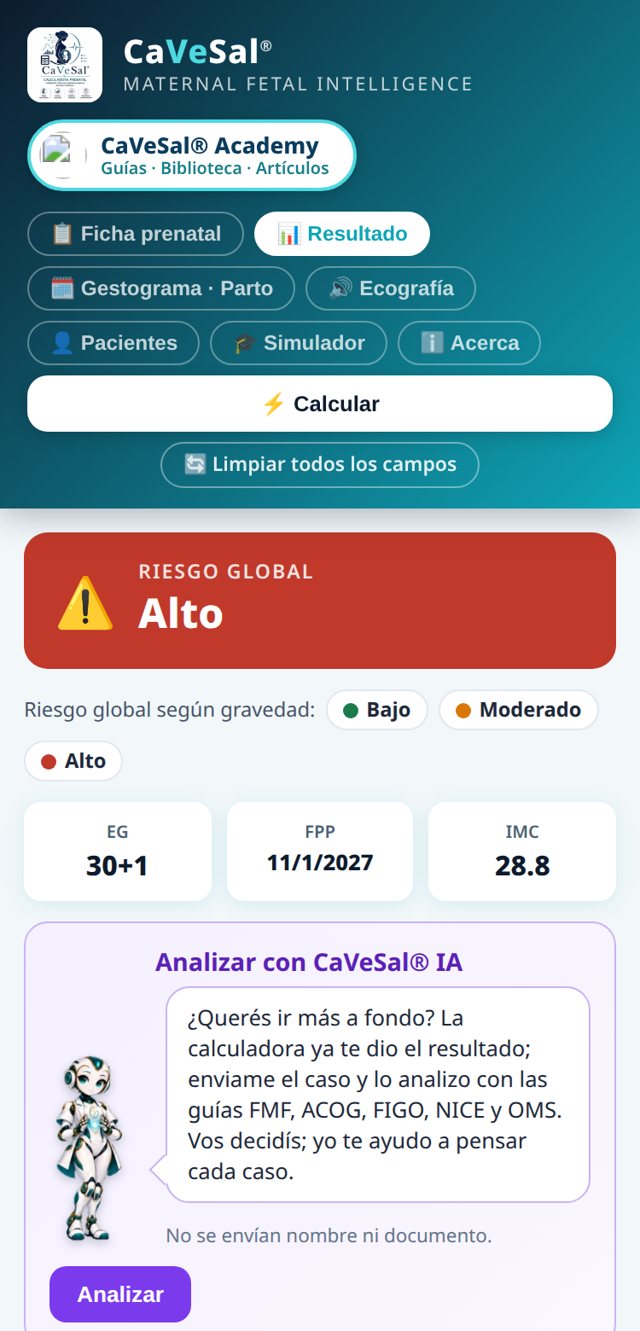
The output panel. It is built when you tap "⚡ Calcular" (Calculate) in the header (visible from any tab) and gathers all the findings from every other tab into a single report, with the management to follow.
📊 Before and after calculating
No data: the Result says "No tenés datos cargados" (No data entered) and tells you to enter data in the Prenatal record and press Calcular. No color is shown, so it never gives a result that does not apply.
Global risk by severity: the legend 🟢 Bajo (Low) · 🟡 Moderado (Moderate) · 🔴 Alto (High) is always visible. When you calculate, the gray box turns to the matching color and the findings and action plan appear below.
Analizar con CaVeSal® IA (Analyze with CaVeSal® IA): the little robot appears from the start, inviting you to send the case once you calculate. Name and ID are not sent.
Exportar resultado (Export result): PDF and Word buttons. If you have not calculated yet, they tell you there is no data. In the demo they appear with a lock 🔒.

🎨 How to read the results
All Calculator modules use the same visual language, so interpreting a result is always equally quick, whatever you are calculating:
Color code by risk/alert level: 🟢 green = normal/low risk · 🟡 yellow/orange = moderate, requires closer follow-up · 🔴 red = high risk, requires action or referral.
Each result with a relevant finding includes, in this order: the value or data that triggered the alert, the clinical interpretation in plain language, the suggested management (what to do, how often, whom to refer to), and the source of the recommendation (FMF, ACOG, NICE, WHO, CLAP, Fetal Medicine Barcelona, etc.).
When "⚡ Calcular" builds the global report, it automatically groups these same findings into an "Action plan", ordered by urgency: first what requires attention today/urgently, then routine follow-up, with the next suggested visit date according to the global risk level.
⚡ Comprehensive prenatal risk calculation
This is the "⚡ Calcular" button in the header: it goes through everything you entered in 📋 Prenatal record, 🗓️ Gestogram·Delivery and 🔊 Ultrasound, and builds here, in 📊 Result, a consolidated report with all relevant findings together.
The app goes through all the data entered and builds a list of findings by clinical domain (Maternal age, Nutritional status, Obstetric history, Blood pressure, 1T ultrasound, Chromosomal screening, Fetal morphology, etc.), each with:
🔹 The data or value that triggered the alert (e.g. "Pre-pregnancy BMI 32.1 — obesity").
🔹 The risk level: low, moderate or high.
🔹 The suggested management (e.g. aspirin dose, visit frequency, additional tests to request).
🔹 The source of the recommendation (FMF, ACOG, NICE, WHO, etc.).
If there are no risk findings in a domain, it simply does not appear in the report — only domains with something to flag are listed.
The report also automatically builds a Recommended supplementation according to the patient's profile: folic acid/methylfolate (dose for the general population or increased risk), iron (dose according to the degree of anemia), calcium (if there is PE risk, with the associated risk reduction), iodine, and omega-3/DHA — each with its exact dose and reference.
It also includes two basic-component calendars, marking what corresponds to the current GA (labeled "AHORA" / "PERÍODO ACTUAL" — Now / Current period), what has already passed and what is still pending:
🔹 Laboratory calendar: 1T panel (first visit: blood count, coagulation, blood group/Rh, serologies, TSH, glucose, lipid profile, urine culture, etc.), 2T panel (24–28 wk: blood count, 75 g OGTT, urine culture, VDRL, HIV, toxoplasmosis if applicable), and 3T panel (35–37 wk: blood count, coagulation, renal/liver profile, VDRL, HIV, GBS).


🗓️ Gestogram · Delivery
Gestational age and calendar, fundal height, and mode-of-delivery prognosis — what is neither record nor ultrasound, but the chronological follow-up of the pregnancy.
🗓️ Gestational age and calendar (LMP / early US)
This module is the basis of all the others — the gestational age (GA) you calculate here syncs automatically with the rest of the calculator.
Choose the mode: "Por FUM" (By LMP — last menstrual period) or "Por ECO precoz" (By early ultrasound) if you have an early scan with the GA already determined.
LMP mode: enter the date of the last menstrual period. The app calculates the GA as of today (or any other date you choose in "Calcular para fecha" — Calculate for date).
Early ultrasound mode: enter the date of the scan and the GA it gave (weeks+days format, e.g. "8+3"). The app automatically compares that GA with the entered LMP and tells you whether the LMP should be corrected, according to these criteria:
🟢 1st trimester (<14 wk): corrected if the difference is ≥5 days.
🟡 2nd trimester (14–28 wk): corrected if the difference is ≥7 days.
🔴 3rd trimester (>28 wk): the LMP is not corrected — for uncertain GA in 3T it is better to use HC, FL or cerebellum as a single parameter (see the "MCA Doppler — Fetal Anemia and Biometry by parameter" section in the 🔊 Ultrasound tab).
With the calculated GA, the app shows a week-by-week calendar (22 to 42 weeks) with the calendar date for each week of pregnancy, marking the term range (37–40 wk) and post-term.
It also includes a reverse calculation: enter a specific week (e.g. "36") and the app tells you which calendar date corresponds to that week for this patient.

📏 Fundal height
Ref: Gomes AG 2001 · CLAP-PAHO/WHO · McDonald formula (symphysis-fundus)
Enter the fundal height in cm (symphysis-fundus measurement, McDonald technique) and the gestational age in weeks+days.
The app shows the percentile (with the P10/P50/P90 reference values for that GA) and classifies the result: normal FH for GA, high FH for GA (>P90), or low FH for GA (<P10) — valid in the 20–36 week range, where FH(cm)≈GA±2.
Depending on the classification, it suggests what to rule out: high FH → fetal macrosomia, polyhydramnios, undiagnosed twins, uterine fibroids, gestational diabetes (request ultrasound). Low FH → FGR, oligohydramnios, GA discrepancy (urgent ultrasound with EFW, consider UA/MCA Doppler).

🏥 Mode-of-delivery prognosis
Ref: Robson · Grobman (ACOG/NICHD) · Bishop (ACOG PB 107 · NICE NG207)
Enter parity and history (previous vaginal births, previous cesareans, spontaneous miscarriages), maternal height (reference: <150 cm risk of cephalopelvic disproportion, <145 cm borderline pelvis), and 3T fetal status (presentation, engagement, current GA), the planned onset of labor (spontaneous, induction or planned cesarean) and the number of fetuses, taken from «Multiple pregnancy» in the record.
The app assigns the probable Robson Group using the 6 WHO variables, including subgroups 2a/2b, 4a/4b and 5.1/5.2 (e.g. Group 5.1: one previous cesarean + cephalic; Group 8: multiple pregnancy), with a planning line for that group. It is a prognosis: the final group is assigned at admission for birth, in the Emergency calculator. If the current GA is under 37 weeks, it notes that a preterm birth moves to Group 10.
If there is a previous cesarean, the Grobman Score is enabled (validated by ACOG/NICHD, predicts the probability of successful vaginal birth after cesarean). Enter the type of uterine scar, the indication for the previous cesarean (recurrent or not), and tick whether there was a previous vaginal birth, previous spontaneous labor, recurrent pregnancy loss, a high-value pregnancy, or previous uterine surgery.
Based on these data, the app indicates whether she is a "Candidata a PVDC" (VBAC candidate — vaginal birth after cesarean), listing the favorable criteria found, or whether a "Cesárea programada indicada" (planned cesarean indicated) applies, with the specific justification (e.g. EFW ≥4500 g, high-value pregnancy).
If you enter the cervical exam (dilation, effacement, station, consistency, position), the app calculates the Bishop Score and classifies it as favorable (more than 8), intermediate (7–8) or unfavorable (6 or less, suggests cervical ripening), per ACOG PB 107 and NICE NG207. With only dilation, effacement and station it shows the simplified Bishop (more than 5, favorable).

🔊 Ultrasound
Everything that is an ultrasound/Doppler study as such, in the same chronological order in which the studies are performed: 1T/2T screening → 2T structural anatomy → 2T/3T fetal Doppler → fetal weight → fetal anemia → 3T fetal well-being (BPP, monitoring).
🔊 Ultrasound · FMF screening (1T/2T, PE, amniotic fluid)
🆕 Expanded sectionRef: FMF/Nicolaides · Snijders 1998 · Sharifzadeh 2019 · Fetal Medicine Barcelona · Gyselaers 2020 · Verlohren 2012 · ISUOG 2024 · SMFM Consult #46 (2018) · ACOG Clinical Consensus No.3 (2022) · Roche/BRAHMS sFlt-1/PlGF
It is the first card of the tab, and the most extensive: it gathers everything assessed in the 1T and 2T screening scans — chromosomal, preeclampsia (maternal Doppler) and amniotic fluid.
🧬 1T chromosomal screening (FMF/Nicolaides)
Choose the type of screening available for this patient: Ultrasound only (NT + markers, no biochemistry) · Combined (ultrasound + biochemistry: PAPP-A, β-hCG, 1T PlGF) · Primary NIPT · Combined + NIPT. Each mode shows its own fields.
Ultrasound only (11–13+6 wk): choose the NT percentile chart (Snijders/FMF 1998 or Sharifzadeh 2019), enter NT and CRL at the time of measurement (45–84 mm), and tick the additional markers: nasal bone (absent: LR+ ~6 for T21), ductus venosus (reversed/absent a-wave = marker of aneuploidy + heart disease), tricuspid regurgitation (associated with T21 and congenital heart disease), and choroid plexus ("butterfly sign" — visible cyst(s) are a soft marker, more associated with T18 than T21 if isolated).
Combined: enter the numerical T21/T18/T13 risk (1/X) given by the screening software, and the MoM values of PAPP-A (<0.4 MoM ↑ risk of PE/FGR/aneuploidy), free β-hCG (>2.5 MoM suggests T21, <0.4 MoM suggests T18/T13) and 1T PlGF (<0.5 MoM high PE risk, <0.7 moderate).
• Fetal Medicine Barcelona (preferred, default): very high ≥1/10 → genetic counseling and invasive testing with microarray (NIPT may be accepted if the patient prefers, except with an ultrasound anomaly or increased NT) · high 1/11–1/250 → NIPT or invasive testing by informed choice; with an ultrasound anomaly or NT >p99, chorionic villus sampling + microarray · intermediate 1/251–1/1100 → offer NIPT · low <1/1100 → give the result and explain its limitations.
• Nicolaides 2005 / FMF (alternative): two-stage strategy. High ≥1/100 → invasive testing · intermediate 1/101–1/1000 → second 1T scan (nasal bone, tricuspid regurgitation or ductus venosus) and chorionic villus sampling if the adjusted risk reaches 1/100 · low <1/1000 → no further tests.
• Another published variant, not included in the selector: FIGO 2015 (>1/100 cell-free fetal DNA or invasive testing · 1/101–1/2500 cell-free fetal DNA · <1/2500 none).
The NT percentile chart (Snijders 1998, default, or Sharifzadeh 2019) is chosen separately and does not change with this selector.
NIPT: record the result (normal, T21/T18/T13 positive, Turner/45,X, Klinefelter/47,XXY, microdeletion, sample failure) — the app reminds you that a positive NIPT is not diagnostic and requires invasive confirmation.
🩺 Uterine artery and Ophthalmic Artery Doppler (PE screening) — 1T and 2T
This is the maternal Doppler for screening preeclampsia and systemic vascular compromise — different from fetal Doppler (UA, MCA), which has its own card further down.
Uterine arteries (PI): enter the right and left PI, in both 1T and 2T — the app automatically calculates the mean PI of both. Cut-offs: 1T alert from PI ≥1.90 (moderate) and ≥2.35 (high, >p95) · 2T from PI ≥1.44 (moderate, p90-95) and ≥1.80 (high, >p95).
Ophthalmic Artery (OA): enter PSV1 and PSV2 — the app calculates the PSV2/PSV1 ratio automatically. ≥0.70 borderline zone · ≥0.78 high risk of preeclampsia/vascular compromise (integrate with uterine PI and PlGF). Used the same way in 1T (screening) and 2T/3T (prognosis in established PE/HDP).
2T cervical length (mm): <25 mm short cervix · <15 mm very short.
sFlt-1/PlGF (2T/3T): enter the ratio and the GA at which the test was done (it matters to distinguish the 85 vs. 110 cut-off). Interpretation (Roche/BRAHMS): ≤38 rules out PE in the next week · 38–85 intermediate if <34 wk (38–110 if ≥34 wk) · >85/110 suspected PE · >655 imminent PE.
💧 Amniotic fluid
Enter the deepest vertical pocket (DVP/SDP) and/or the AFI (amniotic fluid index), and choose which guideline to use to classify the AFI: ACOG/SMFM 2022 (with borderline zones) or ISUOG 2024 (classic absolute cut-offs) — both charts coexist in the app because they do not match exactly.
📊 AFI — ISUOG 2024: <5 cm oligohydramnios · 5–24.9 cm normal · ≥25 cm polyhydramnios.
📊 AFI — ACOG/SMFM 2022: <5 cm oligohydramnios (<3 cm severe oligohydramnios) · 5.1–8.0 cm lower borderline · 8.1–18 cm normal · 18.1–24.9 cm upper borderline · 25–29.9 cm mild polyhydramnios · 30–34.9 cm moderate polyhydramnios · ≥35 cm severe polyhydramnios.


🔬 Anomaly Scan (2T) — 7 systems
🆕 New sectionRef: ISUOG Practice Guidelines (2020/2023) — fetal CNS, face, heart · Paladini & Volpe (2018) · Jeanty P et al. 1984 · Mayden KL et al. 1982 · Corteville JE et al. 1991/1992 · FMF/Nicolaides · CDHSG / Jani et al. 2007
Structured checklist by system (18 to 24 weeks), immediately after FMF screening — it is the same 2T scan visit, so this section sits right after the one above instead of after Doppler/EFW.
Enter the GA of this study (weeks+days) — it is shared by the 7 systems and by Placenta accreta, and is used by items with a GA-dependent cut-off (TCD, nuchal fold, renal pelviectasis, megabladder).
🧠 CNS
Cavum septi pellucidi (absent ⚠️) · Thalami (symmetrical/asymmetrical ⚠️) · Skull shape (oval normal / "lemon" sign ⚠️ / "strawberry" sign ⚠️) · Skull bone continuity (intact/defect ⚠️).
Lateral ventricular atrium: choose the measurement scheme (A: classic 3 levels — normal <10 · mild 10–12 · moderate 12.1–14.9 · severe ≥15 mm; or B: ISUOG 2 levels — normal <10 · mild 10–15 · severe >15 mm) and enter the value in mm (inner-to-inner measurement at the level of the choroid plexus glomus).
TCD (mm, for reference — it does not trigger an automatic alert; the real cut-off is by p5–p95 percentile chart by GA) · Banana sign (present ⚠️) · Cerebellar vermis agenesis ⚠️ · Cisterna magna (normal 3.0–10.0 mm, <2–3 mm obliterated, >10 mm mega cisterna magna) · 2T nuchal fold (valid 15.0–20.6 wk, normal <6.0 mm, ≥6.0 mm major aneuploidy marker).
😶 Face
Orbits (present and symmetrical / altered ⚠️) · Nose (normal shape / flattened or absent ⚠️) · Maxilla (intact/defect ⚠️) · Palate (intact/cleft ⚠️ — requires a retronasal coronal view, harder to visualize than the lip) · Upper lip (intact/unilateral defect ⚠️/bilateral defect ⚠️). Lip and palate are assessed together: management and genetic counseling vary according to the exact combination.
Orbital diameters: enter the IOD (inner interorbital diameter), the BOD (outer interorbital/binocular diameter) and, if measured, the OD (individual orbital diameter) — all in mm. The app calculates the IOD/BOD ratio (rule of thirds) and classifies: >0.40 suspected hypertelorism · <0.25 suspected hypotelorism. The IOD is also compared qualitatively against the OD as additional support. Tick separately if microphthalmia/anophthalmia is suspected (small OD, rudimentary or absent lens) — it is a field independent of the ratio.
🦴 Spine
Spine (longitudinal + axial view: intact/discontinuity ⚠️) · Skin over the spine (intact/defect ⚠️).
🫀 Chest and heart (+ CDH)
Heart rhythm: regular (normal) · sustained tachycardia (>160 bpm, >10 min) ⚠️ · sustained bradycardia (<110 bpm) ⚠️ · isolated extrasystole · other sustained arrhythmia (with a free-text field to specify the type) — same bpm cut-offs as Fetal Monitoring.
Visceroatrial situs (solitus/inversus ⚠️) · Four-chamber view · Ventricular symmetry and atrial symmetry + foramen ovale · Interventricular septum (defect = VSD ⚠️) · LV and RV outflow tracts · Three-vessel and trachea view (PA>Ao>SVC in decreasing caliber, "V" confluence to the left of the trachea) · Aortic arch (interruption/coarctation ⚠️) · Lungs (homogeneous and symmetrical normal).
Cardiothoracic ratio: choose the method (by area, recommended — normal 0.25–0.33, cardiomegaly >0.35; or by circumferences/diameters — GA-dependent cut-off: >0.50 at 12–15 wk · >0.52 at 18–20 wk · >0.59 at 25–30 wk) and enter the value. Cardiac angle/axis: normal 45°±20° (25°–65°) to the left; >65° points to conotruncal heart disease/CDH, <25° or a right axis to dextrocardia/situs inversus.
Congenital diaphragmatic hernia (CDH) — its own sub-card within Chest and heart: gastric bubble (infradiaphragmatic normal / supradiaphragmatic-intrathoracic ⚠️), side (left/Bochdalek ~85% · right ~10–15%), and O/E LHR (%) — <25% severe · 25–44.9% moderate (TOTAL trial; 35–44.9% if liver herniation) · ≥45% favorable.
🫃 Abdomen
Stomach: present/infradiaphragmatic/left (normal) · "double bubble" image ⚠️ (duodenal/high jejunal atresia, ~30% association with T21) · altered (other, see CDH). Abdominal wall/cord insertion: intact (normal) · omphalocele (covered) ⚠️ · gastroschisis (uncovered) ⚠️.
Renal pelviectasis: AP diameter of the right and left pelvis (mm) — <33 wk: normal <4.0 · mild 4.0–10.0 · obstructive >10.0 mm; ≥33 wk: normal <7.0 · mild 7.0–10.0 · obstructive >10.0 mm.
Kidneys — visualization and position: both visible in usual position (normal) · unilateral absence ⚠️ · bilateral absence ⚠️⚠️ · pelvic ectopic ⚠️. Kidneys — parenchymal appearance: normal/homogeneous · multicystic/dysplastic ⚠️ (correlate with amniotic fluid — bilateral agenesis or bilateral dysplasia usually present with severe oligo/anhydramnios).
Umbilical cord (vessels): 3 vessels (normal) · single umbilical artery ⚠️. 2T/3T megabladder (≥16 wk) — maximum longitudinal diameter (mm), static criterion: pathological if it exceeds (GA in weeks + 12) mm. Filling/emptying cycle (dynamic): normal 25–45 min · does not empty after 40–60 min ⚠️. "Keyhole" sign (PUV): present ⚠️.
🦵 Limbs
Short femur for GA and short humerus for GA (checkboxes). Hands and feet — orientation (normal / altered ⚠️, other: contractures, syndactyly, etc.). Digits — number (5 per hand/foot normal / suspected polydactyly ⚠️ — soft marker associated with trisomy 13 and genetic syndromes such as Meckel-Gruber or Bardet-Biedl if accompanied by other findings; isolated, prognosis is usually good).
3 segments per limb (so as not to miss reduction defects — phocomelia, amelia — when only the femur/humerus is looked at in isolation): upper limb → humerus, radius/ulna, hand (each present/absent ⚠️); lower limb → femur, tibia/fibula, foot (present, normal orientation / absent ⚠️ / present with suspected clubfoot (talipes equinovarus) ⚠️).
🟤 Placenta, cord, AF, cervix
Placenta — location: fundal/corporal/lateral away from the internal os (normal) · low-lying (edge <20 mm from the internal os) ⚠️ — different from the 3T "Placenta previa" checkbox (Prenatal record → Current pregnancy), which confirms in 3T what is a 2T finding here. Cord — placental insertion site: central/paracentral (normal) · marginal ("battledore") ⚠️ · velamentous ⚠️⚠️ (risk of vasa previa — confirm with color Doppler over the internal os; elective cesarean if confirmed; risk of FGR). It is a separate field from the number of cord vessels (see Abdomen).
img/manual-calc-morfologia-*.png🔴 Placenta accreta spectrum (PAS) — CaVeSal Classification
🆕 New sectionRef: FIGO/Jauniaux 2018 · ISUOG/Jauniaux 2016–2018 · ACOG/SMFM Obstetric Care Consensus No.7 (2018/2021) · MSPyBS Paraguay
Placenta accreta spectrum (PAS: accreta/increta/percreta). Main risk factor: previous cesarean + placenta previa/low anterior insertion.
Risk factors: number of previous cesareans (0/1/2/≥3), previous uterine curettage, previous uterine surgery (myomectomy, etc.), history of Asherman syndrome. Placenta previa/low insertion and maternal age >35 or a history of IVF are not duplicated here — they are taken from the Anatomy (2.7) and History fields, where they are already entered.
2D ultrasound signs (each Yes / Unsure / No): loss of the clear zone, myometrial thinning (<1 mm), irregular placental lacunae ("Swiss cheese"), interruption of the bladder-uterine interface/wall, placental bulging toward the bladder, focal exophytic mass (transserosal invasion).
Color Doppler signs (each Yes / Unsure / No): uterovesical hypervascularity, subplacental hypervascularity, bridging vessels, lacunae feeder vessels, parametrial involvement.
If you already have a confirmed diagnosis (surgical or histopathological), you can enter the FIGO Classification: Grade 1 (Accreta) · Grade 2 (Increta) · Grade 3a (Percreta limited to the uterine serosa) · Grade 3b (Percreta with bladder invasion) · Grade 3c (Percreta with invasion of other pelvic tissues/organs, ± bladder).
img/manual-calc-acretismo.png🩸 Fetal Doppler — 2T/3T (UA, MCA, CPR, ductus venosus, advanced)
Ref: Baschat AA & Gembruch U. UOG 2003 · Arduini & Rizzo 1990 · Mari NEJM 2000 · ISUOG 2020 · TRUFFLE Study
Basic Doppler
Enter the GA at the study (weeks+days) and the available values: Umbilical Artery (PI, RI), Middle Cerebral Artery (PI, and PSV in cm/s for anemia screening), and Ductus Venosus (PIV).
The app automatically calculates the CPR = MCA/UA, with its dynamic P5 threshold according to GA (e.g. at 33 weeks, P5≈1.07) and flags it as abnormal if it falls below.
The result shows each parameter with its individual percentile (UA PI, MCA PI, CPR, DV PIV), indicating which are abnormal and what they mean (e.g. increased UA = placental resistance; abnormal CPR = hemodynamic redistribution).
Advanced hemodynamic Doppler
2T/3T tricuspid regurgitation (TR): marker of right heart dysfunction. Indicate if DV is abnormal or fetal cardiomyopathy is suspected (not to be confused with 1T TR, which is chromosomal screening).
Aortic Isthmus (AoI): enter PI and diastolic flow (normal/reduced/absent/reversed). It reflects cerebral redistribution and left ventricular afterload — retrograde flow indicates severe neurological compromise. Indicate if MCA or CPR are abnormal in preterm FGR.
Umbilical Vein Pulsations (UVP): umbilical venous pulsatility is a late sign of fetal decompensation — it indicates heart failure with venous congestion, associated with high perinatal mortality.
If the advanced Doppler is abnormal and the GA is <34 weeks, the app reminds you of lung maturation (betamethasone 12 mg IM every 24 h x2 doses, ref. ACOG PB 127/RCOG) and that delivery is decided according to clinical and biophysical progress, coordinating with neonatology.
Ophthalmic Artery — HDP/PE prognosis (2T/3T)
In a patient with established HDP/preeclampsia, enter the ophthalmic artery PSV1 and PSV2 — the PSV2/PSV1 ratio assesses the degree of systemic vascular compromise: ≥0.78 severe compromise · 0.70–0.77 borderline · <0.70 favorable.
A ratio ≥0.78 indicates a higher risk of severe FGR and early-onset PE, with poor maternal-fetal prognosis — the app recommends urgent referral to Fetal Medicine and assessment of sFlt-1/PlGF, renal/liver function and fetal well-being.

👶 Estimated Fetal Weight (EFW) and growth
Ref: Hadlock 1984 · INTERGROWTH-21 · Figueras 2008 · MFB Protocol 2024
Choose the calculation mode: weight and direct percentile, weight + gestational age, or Hadlock biometry (abdominal circumference + femur length).
Enter the values for the chosen mode. In "Peso + EG → percentil" (Weight + GA → percentile) mode you will see the notice "Estimación de percentil por curvas INTERGROWTH-21st (método simplificado). Para resultado preciso usar software FMF" (percentile estimate by INTERGROWTH-21st curves, simplified method; use FMF software for a precise result) — it is a note about the method and does not mean that mode ignores the chart you have selected (see point 4).
The app calculates the fetal weight percentile and classifies it: SGA, AGA, LGA, or FGR according to the percentile and — if you have already entered the Doppler — combining both criteria (see Doppler section).
The percentile in the "Weight + GA" and "Hadlock biometry" modes is calculated with the chart chosen in the Figueras 2008 / INTERGROWTH-21 selector — this selector is on the "Mode-of-delivery prognosis" card (🗓️ Gestogram·Delivery tab), but it applies to the whole EFW module (see that section for details).

🩸 MCA Doppler — Fetal Anemia and Biometry by parameter (GA)
Ref: Mari G. et al. NEJM 2000 · Algoritmo propio CaVeSal® · MoM threshold ≥1.50 · Robinson & Fleming 1975 · Hadlock 1984 · Chitty & Altman 2002 · Goldstein 1987 · Campbell & Thoms 1977
In the app it is a single card with 5 sub-tabs: fetal anemia screening by MCA-PSV, plus the different ways to estimate GA from a single biometric parameter (useful when GA by LMP is uncertain, or when FGR/asymmetry is suspected).
Fetal anemia (MCA-PSV)
Enter the GA (weeks+days) and the MCA PSV in cm/s.
The app calculates the MoM (comparing against the expected median for that GA) and classifies: Normal (MoM <1.29, no evidence of anemia, follow-up per protocol) · Possible mild anemia (MoM 1.29–1.49, surveillance, repeat in 1–2 weeks) · Moderate-severe anemia (MoM ≥1.50, indication for cordocentesis and urgent intrauterine transfusion).
🔬 GA by CRL — 1T
Enter the CRL in mm (valid range: 10–84 mm, approx. 6+3 to 13+6 weeks). The app calculates the GA with the formula GA(days) = 8.052×√(CRL×1.037)+23.73, with a margin of error of ±5 days — it is the most accurate measurement for dating the pregnancy, and it shows the corrected LMP and the corresponding EDD.
📏 GA by biometry — 2T and 3T
Enter the available parameters: BPD, HC, AC, FL (in mm) — each calculates its own estimated GA separately. Usage criterion: in 2T use BPD or FL (margin ±1 week); in 3T prefer HC or FL (less variability than BPD); with uncertain or discordant GA in 3T, use HC or FL for the estimate, without formal correction of the LMP. If there is a significant discrepancy between parameters (≥7 days), the app alerts you and suggests assessing fetal asymmetry — considering asymmetric FGR if the AC is the lagging parameter — and recommends moving to the "Asimetría LF/CA" (FL/AC asymmetry) sub-tab.
🦴 GA by humerus length
Enter the humerus length (mm) as an additional GA parameter, useful as an alternative or complement to the femur, especially if skeletal dysplasia is suspected.
🧠 GA by transverse cerebellar diameter (TCD)
Enter the TCD in mm. Between weeks 14–28, the TCD in mm is approximately equal to the GA in weeks (after week 28 the correlation is no longer linear, and the app uses the Goldstein charts). Key advantage: the TCD is independent of growth restriction — it is not affected in FGR, which makes it the most reliable parameter for estimating GA in fetuses with FGR or severe asymmetry. A preserved TCD in a fetus with suspected FGR confirms that the assigned GA is correct; a small TCD for GA is a marker of CNS disease (cerebellar hypoplasia, Dandy-Walker syndrome) and warrants referral.
⚖️ FL/AC asymmetry
Concept: in late, asymmetric FGR, the fetus redistributes flow (brain sparing) — abdominal growth is restricted before head growth. The FL/AC ratio detects this asymmetry early. Enter FL, AC (in mm), and optionally HC (to check for microcephaly: HC <p3 for GA) and the current GA.
Interpretation of the FL/AC ratio: normal 0.20–0.24 · <0.16 = FL disproportionately short relative to AC → suspected limb shortening (dwarfism, skeletal dysplasia) · >0.235 = AC disproportionately small relative to FL → asymmetry / late asymmetric FGR (brain sparing), warrants Doppler (umbilical and MCA) and serial biometry every 2 weeks.


🧬 Fetal Biophysical Profile (BPP)
Ref: Manning 1980 · Vintzileos 1983 · Clark 1989 · Queenan/Spong/Lockwood 7th ed. · MSPyBS Paraguay
Choose the modality according to what you assessed: Complete (Manning, 5 variables, 10 points + NST) · Ultrasound only (8 points, no NST) · Abbreviated (Clark: NST + amniotic fluid) · Vintzileos (graded 0/1/2 + Grannum placental grade, up to 12 points).
Enter the available variables for the chosen modality: fetal breathing movements (FBM), body/limb movements (FM), fetal tone, NST reactivity, and amniotic fluid volume — in the Vintzileos modality, also add the placental grade (Grannum).
Enter the current gestational age — it is a key item: the suggested management depends on the combination score × amniotic fluid status × GA, not just the total score.
The app adds up the score and shows the corresponding management, also indicating whether the amniotic fluid is normal or reduced, because management changes with that status — especially for intermediate scores.
🔹 10/10 or 8/10 with normal fluid: expectant management, usual surveillance.
🔹 8/10 with oligohydramnios: depends on GA — ≥36–37 wk, deliver; preterm, daily Doppler.
🔹 6/10 with normal fluid: reassess in 12–24 h (or 2 h per MSPyBS protocol), or delivery is indicated if at term.
🔹 6/10 with oligohydramnios: delivery if viability is assured.
🔹 4/10 with normal fluid: GA-dependent management — if <32 wk, repeat in 2 h along with corticosteroids, magnesium sulfate and ductus venosus Doppler; cesarean only if it persists or the Doppler decompensates.
🔹 4/10 with reduced fluid: immediate emergency cesarean, regardless of GA (double compromise: acute asphyxia on top of chronic insufficiency).
🔹 ≤2/10 (any fluid): immediate emergency cesarean, regardless of GA or fluid.
img/manual-calc-pbf.png💓 Fetal Monitoring (NST/CTG)
Ref: FIGO Consensus Guidelines (Ayres-de-Campos et al. 2015) · ACOG Practice Bulletin 229/106 · Caldeyro-Barcia R. et al. 1966 · Welt AM et al. 1984 · Dawes GS, Redman CWG et al. (Oxford)
Enter the baseline FHR (bpm) — the app flags tachycardia if >160 bpm or bradycardia if <110 bpm (same criterion as the "Heart rhythm" field in Anatomy — Chest and heart).
Select the variability: absent, minimal, moderate or saltatory.
Tick reactivity — the field shows the corresponding rule as an aid according to the entered GA: 15×15 (≥32 weeks) or 10×10 (<32 weeks).
If you identify a special morphological pattern, choose it from the selector: classic sinusoidal, pseudo-sinusoidal, lambda waves, omega pattern, or W sign.
Classify decelerations (Dips I/II/III, Caldeyro-Barcia) if present.
Separately, tick whether you observe shoulders or overshoot — they are two different findings, each with its own field.
img/manual-calc-monitoreo-fetal.png👤 Patients
Saved records, backup, and the data bridge with the CaVeSal® Clinical Record.
👤 Patient management and backup
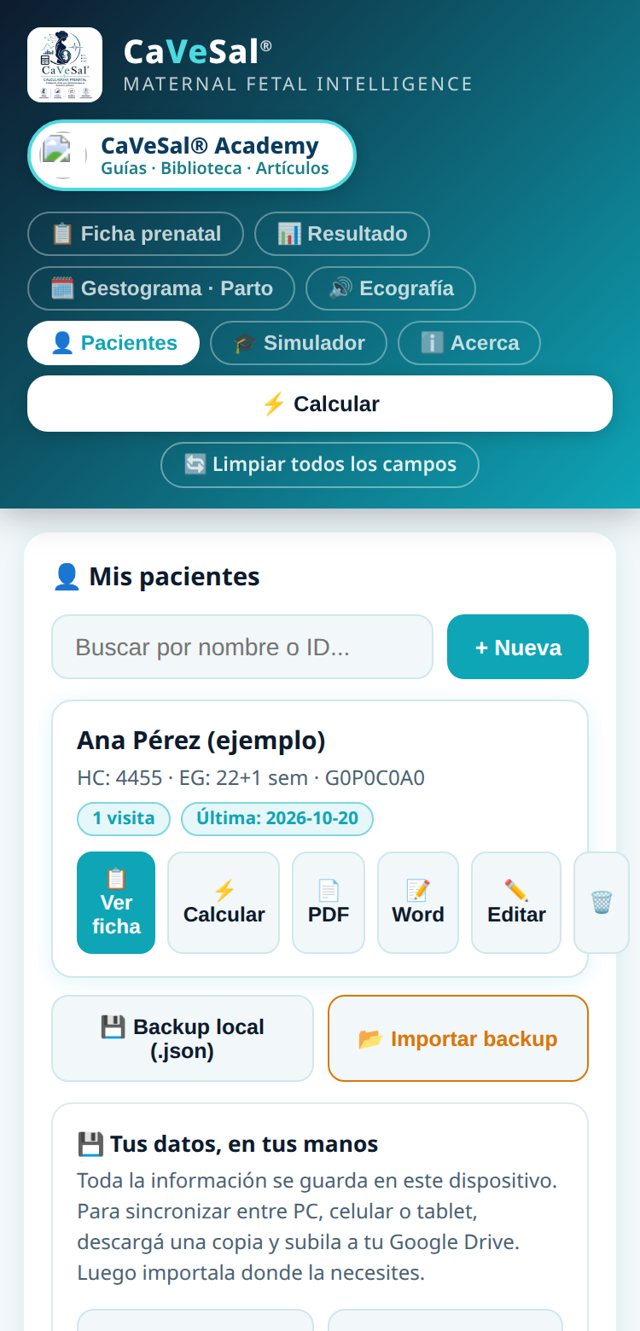
From the Pacientes (Patients) tab, tap "Nueva paciente" (New patient) to create a record, or search for an existing one by ID number.
The data you enter in the clinical modules are saved automatically in the active patient's record. If you ticked assisted reproduction (ART) in Current pregnancy, the app flags it as a risk finding (higher risk of placenta previa, preeclampsia and twins).
Each record automatically shows the obstetric formula (G/P/C/A: pregnancies, births, cesareans, miscarriages) calculated from the entered history, together with height/weight and the global risk classification.
Visit history: within the patient's record, tap "+ Visita" (+ Visit) to record each prenatal visit with: date, GA (auto-calculated from the LMP), current weight, BP, laboratory (Hb, glucose, TSH), ultrasound (EFW + percentile, cervical length, fetal presentation), Doppler/sFlt-1-PlGF in free text, notes/plan, and next appointment date.
Each visit is kept in an editable chronological list — you can modify or delete any recorded visit, and from there you can also reopen that patient directly in the calculator ("⚡ Abrir en calculadora" — Open in calculator) to recalculate her risk with the updated data.
From "Mis pacientes" (My patients), tap "Backup local (.json)" to download a file with all your patients ("Descargar .json" card — Download), and save it to your own Google Drive ("Abrir Google Drive" card) — so you can sync between PC, phone or tablet manually, copying the file from one device to another.
To "Importar backup" (Import backup), choose the .json file and the mode: "Combinar" (Merge — adds the patients from the backup without deleting the ones you already have) or "Reemplazar todo" (Replace all — deletes the current data and replaces it with the backup).
Patient PDF and Word: each card in "Mis pacientes" (My patients) has the 📄 PDF and 📝 Word buttons next to "⚡ Calcular"; they are also inside "Ver ficha" (View record). They export a summary with the patient's data, her visits and the last calculated result. In the demo, the tab appears as Pacientes 🔒 and does not allow data entry.
🔄 Sync with the CaVeSal® Clinical Record
If you also use the CaVeSal® Clinical Record, you can send a patient's clinical data directly from there to the Calculator, without re-entering anything by hand ("Enviar a Calculadora" button in the Clinical Record — full-version feature). This section explains what happens on the Calculator side when those data arrive.
Automatic recognition by Clinical Record ID (id_hc): the Calculator identifies the patient by the "id_hc" field sent by the Clinical Record. If you already had her saved in "Mis pacientes" (because you sent her before), it updates that same record instead of creating a duplicate — you can send the same patient from the Clinical Record as many times as needed as the pregnancy progresses, without generating repeated records. If it does not recognize the id_hc (first time, or patient without an ID entered in the Clinical Record), it creates a new record.
Profile data (height, pre-pregnancy weight, LMP, blood group and Rh, pregnancies/births/cesareans/miscarriages, name): if the field was still empty in the Calculator record, it is filled in automatically. If it already had a different value from the one arriving from the Clinical Record, the app does not overwrite it blindly — the "⚠️ Revisar datos que difieren" (Review differing data) dialog appears, listing each conflicting field so you can choose which value stays (the one you already had saved or the one coming from the Clinical Record).
History, serologies and vaccines (chronic hypertension, pregestational diabetes, thrombophilia, heart disease with WHO class, HIV/Hepatitis/Syphilis history, Coombs, VDRL, toxoplasmosis, Chagas, GBS, Tdap/influenza/RSV/COVID — whatever you have entered in the Clinical Record): these data are not mixed with the editable fields of "Editar paciente" (Edit patient) — they arrive read-only and are shown separately in "Ver ficha" (View record), under the "🩺 Datos clínicos vinculados desde HC" block (Clinical data linked from the Clinical Record). Only those with a positive or entered value are shown — each item the patient does not have is not listed, so the record is not cluttered.
Current visit data (BP, weight, fetal presentation, Hb, TSH, cervical length, Doppler, glucose, EFW, notes): these are always added as a new visit in the history — they never replace a saved visit. They appear in the record exactly like a manually entered visit, with the same fields described in point 4 of "Patient management" above.
img/manual-calc-puente-hc.png🎓 Simulator
Fictional cases to train prenatal care decisions with the same criteria the calculator uses. Available in the full version; in the demo the tab appears with a padlock.
🎓 Training cases
The app presents the patient with a data panel (GA, BP, laboratory or ultrasound results), you choose the management and the case moves forward. Each answer shows an explanation and the source with its link.
Open the 🎓 Simulador (Simulator) tab and choose a case. The Con reloj (With clock) switch sets a time limit for each decision; if it runs out, it counts as unanswered.
Available cases (one source per topic):
🔹 Preeclampsia screening and prevention — FIGO 2019.
🔹 Gestational hypertension and preeclampsia — ACOG PB 222 (2020).
🔹 From screening to FGR (evolving case) — the same patient from week 12: trisomy screening (Fetal Medicine Barcelona cut-offs; Nicolaides 2005 and FIGO 2015 as alternatives in the text), aspirin (FIGO 2019), anomaly scan and uterine Doppler at 20 weeks, and growth scan at 32 weeks with the EFW percentile from the Figueras chart. From there the case randomly follows one of three paths: stage I FGR, stage II FGR or SGA, each with its follow-up, timing and mode of delivery according to the Fetal Medicine Barcelona protocol.
In evolving cases, a notice at the start of the scene indicates what happened. Since the path is drawn at random, repeating the case may give you another one.
At the end, the feedback shows the percentage of correct answers, the time, how the case evolved, each decision with the best answer and the sources. The Copiar resultado (Copy result) button copies a text summary.
ℹ️ About
CaVeSal® ecosystem, clinical author, bibliographic bases for the whole calculator, and legal notice. This tab had not been documented in the manual until now.
📲 Invite your patient
🆕 New sectionTwo free apps from the CaVeSal® ecosystem, depending on each patient's stage, plus the complete ecosystem — with their QR code to share during the consultation.
CaVeSal® Mamá (mama.cavesal.app): pregnancy, birth, breastfeeding and baby development — for pregnant or postpartum patients.
CaVeSal® Mujer (mujer.cavesal.app): gynecological health and the cycle outside pregnancy — for patients who are not pregnant.
CaVeSal® Ecosystem (cavesal.app): access to all the apps in the ecosystem, including the Clinical Record and those added over time.
👨⚕️ Clinical author
🆕 New sectionDr. Carlos Vera Salerno — Training in Maternal-Fetal Medicine. FMF/Nicolaides methodology and guidelines: ACOG, FIGO, NICE, IADPSG, ATA, WHO, EBCOG, Fetal Medicine Barcelona.
Medical degree, Physician and Surgeon (Paraguay), recognized as equivalent to the Spanish degree of Licenciado en Medicina. Specialist in Obstetrics and Gynecology.
Postgraduate studies in General and Obstetric-Gynecological Ultrasound, Gynecological and Reproductive Endocrinology, Higher Education Teaching and Public Health. Training in Artificial Intelligence and emerging digital tools applied to professional practice.
National Trainer in Sexual and Reproductive Health, Code Red and Prenatal Care. Member of the National Technical Committee on Immunization (Paraguay).
University lecturer at undergraduate and postgraduate level in Obstetrics and Gynecology, Ultrasound, and Gynecological and Reproductive Endocrinology.
Member of the FLASOG Scientific Committee (2024–2026). Member of scientific societies in Paraguay (FPGO, SOGON, SOGIA, SODIAP and SEGIRP). President of FPGO (2023–2026).
📚 Clinical bases
🆕 New sectionComplete list, by clinical domain, of the sources supporting each Calculator module. It is the reference shown inside the app under "Acerca → Bases clínicas" (About → Clinical bases) — useful to see at a glance which guideline supports each calculation before citing it to a colleague or a patient.
Chromosomal screening: Fetal Medicine Barcelona (risk cut-offs) · Nicolaides 2005 / FMF · Snijders 1998 · Sharifzadeh 2019 · Kagan · Cicero.
Preeclampsia: FMF · ISSHP · Roche/BRAHMS (sFlt-1/PlGF) · Fetal Medicine Barcelona. Hypertensive disorders: ACOG PB No.222 (2020) · FIGO Guidelines (2019) · ISSHP (2021).
Gestational diabetes: IADPSG 2010 · ADA 2026 · ALAD 2019 · WHO. Thyroid: ATA Guidelines 2017 · Endocrine Society · ACOG. Supplementation: WHO · ACOG · NICE · FIGO · Endocrine Society 2024 · EBCOG 2024 · Cochrane.
Fetal biometry: Hadlock 1984 · Robinson & Fleming 1975 (CRL/LMP) · Chitty & Altman 2002 (humerus) · Goldstein 1987 (cerebellum) · Jeanty 1983/1984 · Mayden 1982 · Chitty 1994 · INTERGROWTH-21st · Figueras & Gratacós 2008. Fetal growth/SGA/FGR: Figueras F. EJOGR 2008 · MFB Protocol Nov-2024 · ISUOG Delphi Consensus 2020.
UA/MCA/CPR Doppler: Ciobanu A et al. (FMF) UOG 2019. Advanced hemodynamic Doppler: Baschat AA 2011 · TRUFFLE Study Group UOG 2020 · ISUOG FGR 2020 · Gratacós & Torres, MFB protocol 2023. Ophthalmic Artery: Gyselaers 2020 · Verlohren 2012 · Kaitu'u-Lino 2018 · Fetal Medicine Barcelona.
Fetal anatomy: ISUOG Practice Guidelines 2020/2023 (CNS, face, heart) · Paladini & Volpe 2018 · Jeanty/Mayden (orbital diameters) · Corteville 1991/1992 (pelviectasis) · FMF/Nicolaides (megacystis/LUTO) · CDHSG/Jani 2007 (O/E LHR, CDH). Placenta accreta: FIGO/Jauniaux 2018 · ISUOG/Jauniaux 2016-2018 · ACOG/SMFM Obstetric Care Consensus No.7.
Fetal anemia: Mari G. et al. NEJM 2000 (MCA/PSV Doppler) · Detti L et al. AJOG 2002. Monochorionic twins/FGR: Torres X 2017 · Gratacós E UOG 2007 · ISUOG 2020.
Fetal Biophysical Profile: Manning 1980 · Vintzileos 1983 · Clark 1989 · Queenan/Spong/Lockwood 7th ed. · MSPyBS Paraguay. Fetal Monitoring (CTG): FIGO Consensus (Ayres-de-Campos 2015) · ACOG PB 229/106 · Caldeyro-Barcia 1966 · Welt 1984 · Dawes/Redman (Oxford).
Amniotic fluid: SMFM Consult #46 (2018) · ACOG Clinical Consensus No.3 (2022) · ISUOG 2024. Lung maturation (<34 wk): ACOG PB 127 · RCOG Green-top 7. MgSO₄ neuroprotection (<32 wk): ACOG PB 455 · WHO 2015.
Serologies: HIV — EMTCT Plus Paraguay 2024 · DHHS 2024 · PAHO · ACOG. Syphilis — CDC 2021 · PAHO Elimination of MTCT 2024 · EMTCT Plus 2024 · ACOG. Toxoplasmosis — SMFM Consult Series · Montoya & Remington 2008 · PAHO 2024. CMV — Rawlinson 2017 · Leruez-Ville 2020. Chagas — PAHO 2023 · EMTCT Plus 2024 · Torrico 2018. Hepatitis B — EASL 2017 · ACOG · EMTCT Plus 2024. Hepatitis C — EASL 2020 · AASLD · ACOG. Rubella — CDC · PAHO · ACOG.
Intrahepatic cholestasis (ICP): MINSAL Chile Perinatal Guide 2015 · RCOG Green-top No.43 (2022) · SMFM Consult Series No.53 · Williamson 2018 · Ovadia 2019 · ACOG · EASL.
Fundal height: Algoritmo propio CaVeSal®, based on Gomes AG RBGO 2001 · CLAP-PAHO/WHO. Weight gain: IOM/NAS 2009 · ACOG. Mode of delivery: Robson · Grobman (NICHD) · ACOG.
⚠️ Legal notice
🆕 New sectionCaVeSal® is a clinical support tool for trained health professionals. It does not replace the treating physician's clinical judgment or individualized assessment. All clinical decisions are the sole responsibility of the health professional.
Intellectual property: CaVeSal® implements proprietary algorithms and calculation formulas, developed and integrated in an original way from the cited bibliographic references. The regression coefficients used are original, derived from our own analysis of the reference literature. It does not reproduce third-party copyrighted tables. References to scientific publications are solely for academic attribution and clinical validation.
The mention of guidelines, scientific societies or institutions (FMF, ACOG, FIGO, WHO, ALAD, ADA, IADPSG, CLAP, IOM, FPGO, FLASOG, among others) is solely for bibliographic attribution. None of these institutions sponsors, endorses or certifies CaVeSal®.
🔗 More CaVeSal® resources
Already have your key? Want to explore the rest of the suite?
Questions about a module? Write to us at drverasalerno@gmail.com · Last updated: October 2026